Science · Code · Curiosity

Books about Games
Some of the books about games, fiction and non-fiction, that I've read.
Fiction
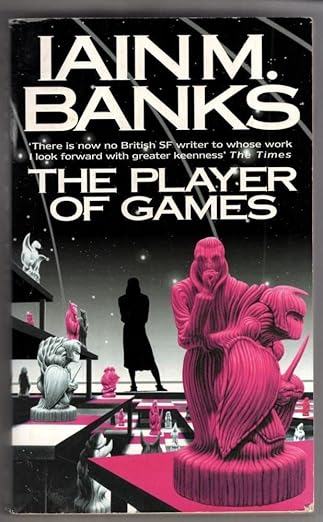
The Player of Games - Iain M. Banks
The Player of Games is part of Iain M. Banks’ Culture series about a citizen of the Culture, and professional game-player, Gurgeh, visiting an alien planet to play a game that determines the organisation and direction of their government.
The game he plays is some sort a war game, and for some reason Gurgeh is able to play it better than the veteran players, and the computers that otherwise have super-human intelligence.
But the moves could become a language, and Gurgeh thought he could speak the language now, well enough (tellingly) to lie in it… so he made his moves, and at one moment, with one move, seemed to be suggesting that he had given up… then with his next move he appeared to indicate he was determined to take one of several players down with him… or two of them… or a different one… the lies went on. There was no single message, but rather a succession of contradictory signals, pulling the syntax of the game to and fro and to and fro until the common understanding the other players had reached began to fatigue and tear and split.
In the midst of this, Gurgeh made some at first sight inconsequential, purposeless moves which - seemingly suddenly, apparently without any warning - threatened first a few, then several, then most of the troop pieces of one player, but at the cost of making Gurgeh’s own forces more vulnerable. While that player panicked, the priest did what Gurgeh was relying on him doing, rushing into the attack.
— Iain M. Banks, The Player of Games
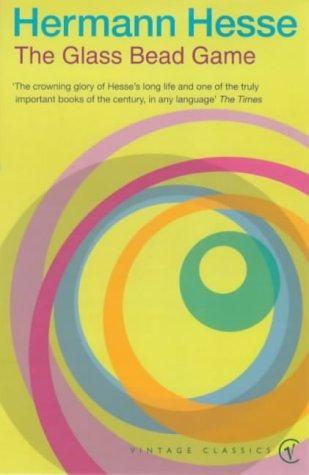
The Glass Bead Game - Hermann Hesse
My dad recommended this book to me, after learning I'd become interested in Go. The book wasn't really what I was expecting, and is pretty heavy going. It is set in a futuristic, scholarly society called Castalia, where intellectuals devote their lives to studying, teaching, and playing the mysterious “Glass Bead Game”. The game itself it not described in detail, and is quite abstract. It involve music, mathematics, art, and not many glass beads. The book tackles the question of whether a life devoted purely to intellectual perfection is meaningful if it's disconnected from human experience.
These rules, the sign language and grammar of the Game, constitute a kind of highly developed secret language drawing upon several sciences and arts, but especially mathematics and music (and/or musicology), and capable of expressing and establishing interrelationships between the content and conclusions of nearly all scholarly disciplines. The Glass Bead Game is thus a mode of playing with the total contents and values of our culture; it plays with them as, say, in the great age of the arts a painter might have played with the colours on his palette.
I don't know whether my life has been useless and merely a misunderstanding, or whether it has a meaning.
— Hermann Hesse, The Glass Bead Game
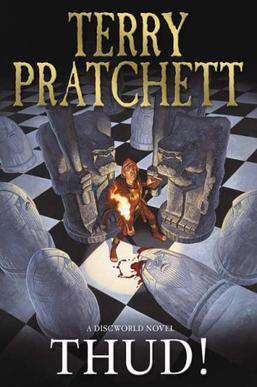
Thud! - Terry Pratchett
One of my favourite authors writing about a game, which was created for the book (I own a copy) How could I resist? I love the Discworld series, especially the watch books. The game is a perfect information game like chess or go, except it's asymmetrical with the dwarf side and troll side having very different moves. It must be very hard to design and good asymmetric, perfect information, strategy game. From what I remember it was pretty good, and not obvious how to play well. In a full game, players must play both sides so you have to understand how to play both sides, and any advantage a side has is cancelled out.
He hated games they made the world look too simple. Chess, in particular, had always annoyed him. It was the dumb way the pawns went off and slaughtered their fellow pawns while the king lounged about doing nothing. If only the pawns would've united ... the whole board could've been a republic in about a dozen moves.
— ― Terry Pratchett, Thud!
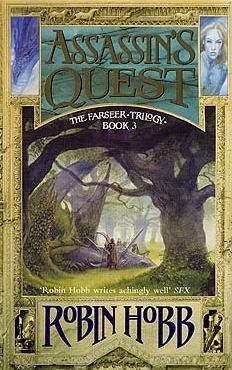
Assassin’s Quest - Robin Hobb
This book isn't really about games, but it is part of one of my favourite book series. A fictional game is described, which is used to teach the protagonist some strategy. It is also somewhat mystical, with the idea that in order to play well, you need to get into a different state of mind. I didn't know about Go the first time I read the book, but was reminded of it the second time, despite some obvious difference (like the red stones).
I soon found myself caught up in the play of the stones. It was strangely soothing: the stones themselves were red, black and white, smoothly polished and pleasant to hold. The game involved each player randomly drawing stones from the pouch and then placing them on the intersections of lines on a patterned cloth. It was a game at once simple and complex.
Five games later, I grasped the brilliant simplicity of Nighteyes’ noose tactic. It had lain before me all that time, but suddenly it was as if I saw the stones in motion rather than resting on the vertices of the cloth’s pattern. In my next move, I employed it to win easily. I won the next three games handily, for I saw how it could be employed in a reverse situation as well.
— Robin Hobb, Assassin’s Quest
So many more to add
Leave a comment
Comments are moderated and will appear after approval.